...dates back to the FDR administration.Barr: We have regulations coming fast and furious. telling people were kind of stoves they can use and what kind of cars they have to drive and eliminating cars and so forth yeah, those are those are the threats to democracy pic.twitter.com/cIZRyVcVyo
— Acyn (@Acyn) April 27, 2024
Saturday, April 27, 2024
Pretty Sure What He’s Describing…


I Wonder If The Supremes Are Taking This Scenario Into Consideration 🤔
“At the end of the day, it wouldn’t be carried out.”
— Asha Rangappa (@AshaRangappa_) April 27, 2024
Maybe it wasn’t carried out because at the end of the day, he figured he’d probably go to jail if he did 🤔 https://t.co/64kMyajH3t
Friday, April 26, 2024
Um 😕
According to information obtained Friday, university spokesperson Ben Johnson said once the troopers began using force on the students around 10 p.m., the state troopers on the roof switched to long-range firearms as part of their protocol.
— The Lantern (@TheLantern) April 26, 2024
Read more:https://t.co/vjhr7zAcVa
According to information obtained Friday, Johnson said once the troopers began using force on the students around 10 p.m., the state troopers on the roof switched to long-range firearms as part of their protocol.
“Ohio State Highway Patrol provided overwatch support, which is a standard safety measure when they assist with large gatherings,” Johnson’s statement said. “We don’t discuss specific public safety protocols. In general, overwatch support is armed, and the team carries standard equipment, including firearms, that would only be used reactively to protect the safety of all present, including demonstrators.”This is where I remind the audience that none of the four dead students at Kent State in 1970 were part of the demonstration.
And the National Guard were completely exonerated, and the students (who were just on campus) were blamed.
😶
It’s A Dog’s Life 🐶
Oh, I don’t know, the news today gave a lot of people on the Left some happiness.This guy hasn’t had a sincere and joyful laugh since the day he shipped Junior off to boarding school in Pennsylvania. pic.twitter.com/hoygTnaKVV
— Ron Filipkowski (@RonFilipkowski) April 26, 2024
There’s far too much demonization in our politics. I mean, just because MAGA types have bad ideas doesn’t mean they’re the kind of people who would shoot puppies.
— Paul Krugman (@paulkrugman) April 26, 2024
Oh, wait.https://t.co/e9CmIwsP5k
What’s not to love?South Dakota Gov. Kristi Noem appears to have confirmed that she killed a family puppy that infuriated her by being “untrainable,” and she claims it only proves how “politically incorrect” she is.https://t.co/OQWjUeODSn
— The Daily Beast (@thedailybeast) April 26, 2024
Noem is so done.
— Ron Filipkowski (@RonFilipkowski) April 26, 2024
Toast.
Finished.
Over. pic.twitter.com/6ni0S1RmN9
Kristi sure knows how to hype a book. pic.twitter.com/sZBsZxUpA9
— Ron Filipkowski (@RonFilipkowski) April 26, 2024
I’m struggling to find anyone who sides with Noem on this one. Maybe Ted Nugent. pic.twitter.com/6YBXeueaGI
— Ron Filipkowski (@RonFilipkowski) April 27, 2024
Are we sure we know how many kids she’s had?A 14-month-old dog is a “baby that doesn't know any better,” hunting dog trainer Dan Lussen tells Rolling Stone on Governor Noem's execution of Cricket. "To me, it's a lack of guidance by the owner, or training by the owner, or discipline of the owner."https://t.co/e1oKAkaowW
— nikki mccann ramírez (@NikkiMcR) April 26, 2024
Talk about somebody who shouldn’t even be elected dog catcher.If there's anything a politician should avoid saying in public, it’s that they murdered a perfectly healthy puppy.
— Rolling Stone (@RollingStone) April 26, 2024
But to South Dakota Governor Kristi Noem, a willingness to shoot a dog who was “the picture of pure joy” proves her governmental chops.
🔗https://t.co/uC5F7MUW5d pic.twitter.com/QyG6YcQREB
I know I speak for many on here when I say I would personally love to donate to @propublica funds to send a half-dozen investigative journalists to South Dakota to find them https://t.co/aFfMmBmiXK
— George Conway (@gtconway3d) April 26, 2024
Oh, look. Donald Trump has a review on Amazon promoting Noem’s puppy killing book. pic.twitter.com/MdQSZ6nPu6
— Ron Filipkowski (@RonFilipkowski) April 27, 2024
I mean, Ted only left Snowflake home alone with massive power outages when he went to Cancun. Even that wasn’t as bad as Noem. pic.twitter.com/5F7TqxdBhi
— Ron Filipkowski (@RonFilipkowski) April 27, 2024
In this South Dakota town, it was a tradition: waffle and eggs, a little pheasant hunting, then drag your puppy into a gravel pit and shoot her in the head. But now the woke mob is taking all of that away.
— New York Times Pitchbot (@DougJBalloon) April 26, 2024
Think what happened to the pets whose deaths she didn’t want to tell us about.
— Ron Filipkowski (@RonFilipkowski) April 26, 2024
Does anyone know what the statute of limitations for animal cruelty is in South Dakota? Asking for no reason in particular ….
— George Conway (@gtconway3d) April 26, 2024
I’ll spare you the details … pic.twitter.com/fERJmGblrQ
— Ron Filipkowski (@RonFilipkowski) April 26, 2024
Ready for the weekend 💙 🐾 pic.twitter.com/DlD0rf4UOf
— Biden-Harris HQ (@BidenHQ) April 26, 2024
Friday Night’s Alright For Fightin’
Trump challenges Biden to courthouse debate: 'Let's do it tonight – I'll wait around!'https://t.co/l730Ms3pQo
— Raw Story (@RawStory) April 26, 2024
"Crooked Joe Biden just announced that he’s willing to debate!" Trump posted on Truth Social during a break in the trial. "Everyone knows he doesn’t really mean it, but in case he does, I say, ANYWHERE, ANYTIME, ANYPLACE, an old expression used by Fighters."I love the idea that an overweight, out of shape old man who snoozes daily in the courtroom, imagines himself a “Fighter.” And if you have to call attention to it, you ain’t one.
"I suggest Monday Evening, Tuesday Evening, or Wednesday Evening at my Rally in Michigan, a State that he is in the process of destroying with his E.V. Mandate,"
"In the alternative, he’s in New York City today, although probably doesn’t know it, and so am I, stuck in one of the many Court cases that he instigated as ELECTION INTERFERENCE AGAINST A POLITICAL OPPONENT - A CONTINUING WITCH HUNT!" Trump posted. "It’s the only way he thinks he can win. In fact, let’s do the Debate at the Courthouse tonight - on National Television, I’ll wait around!"Certainly don’t want to do an organized debate with a moderator and an audience; especially not an audience which could ask questions.
And while Trump, even as POTUS, would have time for such an impromptu event, I think Biden has a bit more of a schedule to keep. One that doesn’t involve being in the courtroom all day, though.
Trump’s longtime Executive Assistant Rhona Graff testified as the state’s second witness. Her testimony was brief, but the prosecution made two key points. https://t.co/urdZJtExtG
— Ron Filipkowski (@RonFilipkowski) April 26, 2024
The second witness called in the criminal prosecution of Donald Trump was his longtime Executive Assistant Rhona Graff. She later became "Assistant to the President" after his election, then Senior VP for Trump Org. She worked for Trump for 34 years until 2021.
Prosecutors began her testimony by pointing out that she was compelled to be there by subpoena and she had a lawyer there hired by Trump but she didn't even know her last name. They showed her a list of contacts that she had previously saved and one of them was Stormy Daniels with her phone number. She was asked if she ever saw Daniels at Trump Tower before 2015 and she said that she had and she was aware that she was a porn actress.
That concluded her testimony, which was simply to show that Trump's Executive Assistant had Stormy's name and phone number on file and that she had been at Trump Tower despite the fact that Trump has repeatedly claimed he didn't know her.He wants to expunge memory of the last witness of the week. Or does he understand the importance of her brief appearance? Probably not.
Unless it’s held after sundown; that might be a problem.
Do I Repeat My? Very Well Then, I Repeat Myself
It’s not meant as comforting so much as explanatory, but if you take the time (especially as a former law student, like Dahlia Lithwick) to read the case most often cited in the arguments, things make more sense. It provides the vocabulary, the context, and the concepts under consideration."Five justices sent the message, loud and clear, that they are far more worried about Trump’s prosecution at the hands of the deep-state DOJ than about his alleged crimes, which were barely mentioned." - @Dahlialithwick & @mjs_DC https://t.co/UZ8BGzvQP3
— Mike Sacks (@MikeSacksEsq) April 26, 2024
I don’t expect even lawyers to have a peerless insight into Supreme Court cases being argued, but there was basically one case being discussed yesterday, and it provided everything from the relevance of Marbury to the concept of “private action.” If you want to understand why the Justices were talking the way they were, that’s the place to start. Then you can intelligently critique their positions (excluding your humble host from those who could offer a better critique).
It ain’t rocket science. 🚀
The Poster Child For Court Reform
As I’ve said, Alito is the best living reason for Supreme Court term limits in line with federal judges (you’ll have to read the article). And I’m a little curious as to how the Court would challenge, or overturn, such laws without someone bringing the case before them. And who would have standing to do that?'Cynical, hypocritical and wrong': Alito buried for blowing off 'facts of this case'https://t.co/51ALlW7Svy
— Raw Story (@RawStory) April 25, 2024
😈
Grey Lady Down!
This is the equivalent of putting a bag of dog poop on the New York Times’ doorstep and setting it on fire. https://t.co/RhGbHH9pU2
— Mark Jacob (@MarkJacob16) April 26, 2024
NYT issues an unprecedented statement slamming Biden for "actively and effectively avoid[ing] questions from independent journalists during his term" and claiming it's their "independence" that Biden dislikes, when it's actually that they're dying to trip him up. https://t.co/0Hw4Ybkbtb
— Dan Froomkin (PressWatchers.org) (@froomkin) April 25, 2024
Gee, what’s this all about?Incidentally, when the NYT got a chance to interview Trump, they went belly up. https://t.co/fW5kx5868d pic.twitter.com/LbrhfYMtqf
— Dan Froomkin (PressWatchers.org) (@froomkin) April 25, 2024
1. The media turned Robert Hur's amateur assessment of Biden's memory into a political crisis.
— Judd Legum (@JuddLegum) March 14, 2024
Collectively, the @washingtonpost, @nytimes, and @WSJ have run 66 articles quoting Hur: a "well-meaning, elderly man with a poor memory"
But when the transcript of the Biden interview… pic.twitter.com/cExzjuKeYz
3. Only the @nytimes included this "photographic recall" anecdote in its own coverage of the transcript. It was included in the last sentence of a 2,500-word article that appeared on page A13 of the paper.https://t.co/bP9htADcUt
— Judd Legum (@JuddLegum) March 14, 2024
5. The "photographic understanding and… recall" comment was not mentioned at all in the Wall Street Journal.https://t.co/bP9htADcUt
— Judd Legum (@JuddLegum) March 14, 2024
7. The transcript shows the Biden interview is not compelling evidence that Biden has memory issues.
— Judd Legum (@JuddLegum) March 14, 2024
But that is a story the nation's top outlets are not eager to tell
For more independent accountability journalism, sign up for Popular Informationhttps://t.co/TfpCItdVSo
"There were many articles after Hur’s report urging Biden to step down. The GOP candidate is a criminal defendant in multiple cases & is sleeping through his trial. Yet there are no Hail Mary columns fantasizing about how Nikki Haley should replace him." https://t.co/EreIkXaPCN
— Aaron Rupar (@atrupar) April 25, 2024
Seriously, NYT, you’re not going to win this one:Is AG going to announce his own impeachment proceedings over this? It’s almost cruel how Joe’s doing that kid. https://t.co/oOlvzqQYZr
— Josh Marshall (@joshtpm) April 26, 2024
AG is the kindest, bravest, warmest, most wonderful human being I’ve ever met in my life. https://t.co/ocXGd5pdAM
— Armando (@ArmandoNDK) April 26, 2024
Biden wants to be re-elected without doing the hard work of giving interviews. But no one deserves an important job that they didn't have to work for.
— New York Times Pitchbot (@DougJBalloon) April 26, 2024
by A. G. Sulzberger
😴
Well, Trump has had his nap today.lmao pic.twitter.com/I9xsbaZlbx
— Aaron Rupar (@atrupar) April 26, 2024
Despite multiple eyewitness accounts over the first two weeks of the trial, I’m sure Snopes says there is still no evidence of this.A source tells Ben Meiselas that Trump is taking ‘full-on bonafide naps’ in the courtroom: Trump looked to be close to deep REM sleep. His lids are heavy.. pic.twitter.com/J2VCN89Fdm
— Acyn (@Acyn) April 26, 2024
Trump lawyers are taking shifts to keep him awake in courtroom: legal analystshttps://t.co/WSqn1PVIoO
— Raw Story (@RawStory) April 26, 2024
"Trump walks in every day with a big stack of papers that appear to be news articles carefully culled for his own reading," MSNBC analyst Lisa Rubin said Friday. "Reading his good press is keeping him at least more energized." He is always accompanied by one of his lawyers directly adjacent to him now when they go to these long and extensive sidebars," Rubin said.
"The strategy is twofold. One, to make sure he always has company and doesn't seem sort of diminished by his solitariness, and the second goal is to keep him awake."
"I just want to clarify that point," Jansing said. "A lawyer will actually change seats to be sitting next to Donald Trump when the others may have gone up to the bench?"
"That's absolutely true," she said."Pics or it didn’t happen!”—Snopes
And remember when Trump was going to attend all the sidebars?
😈
I appreciate that we’ve moved on from reporting that the Republican candidate for president fell asleep in the courtroom during his criminal trial again to analyzing the quality of his snoozes. https://t.co/XpwVR1DAfG
— southpaw (@nycsouthpaw) April 26, 2024
🎂
Trump married Melania in 2005. According to Pecker’s testimony (which was “ blockbuster” and “really great,” according Trump), Trump had affairs the entire period between 2005 and 2015.Sad! pic.twitter.com/1k3FRHeATY
— Aaron Rupar (@atrupar) April 26, 2024
To be fair, Trump now says that’s a picture of Marla Maples.Trump can’t be with Melania on her birthday because he’s on trial for arranging to pay off Playboy model Karen McDougal to keep silent because he had an affair with her during Melania’s entire pregnancy. That’s why he’s missing her birthday. pic.twitter.com/2SwSgasDdy
— Ron Filipkowski (@RonFilipkowski) April 26, 2024
Is there a birthday card for that?“Melania, I can’t be with you on your birthday because I cheated on you and got caught covering it up.” https://t.co/adfUhZX2OW
— PatriotTakes 🇺🇸 (@patriottakes) April 26, 2024
Counsel Against Despair
2/ Justice Barrett rounds this out with her final question:
— Ryan Goodman (@rgoodlaw) April 25, 2024
She gets USG attorney to say there's enough of these private acts to move forward, and Trump's conduct involving pressuring DOJ, Pence etc would be used just for evidentiary value not criminally liable for those acts.⬇️ pic.twitter.com/skhw7T8Fi5
4/ Thanks to @steve_vladeck's commentary here,⤵️ which helped solidify my view of the importance of Justice Barrett's exchange with Trump attorney John Sauer.https://t.co/WFj7UgaqAx
— Ryan Goodman (@rgoodlaw) April 25, 2024
Sometimes legal Twitter doesn’t make me want to gouge my eyes out.6/ My colleague @RickPildes making similar points about the path the Supreme Court can take to expeditiously resolve the case and allow the DOJ prosecution to move forward thanks in part to Trump's attorney's concessions in oral argument.⤵️https://t.co/ZBwDmrNRWN
— Ryan Goodman (@rgoodlaw) April 25, 2024
“Maggie Haberman Is A Big Fat Stinky Liar!”
Greetings from the courtroom where by sheer luck of the draw I am in the front row Trump side so will have some extra nuances to report! Proceedings start at 9:30 & recall that they will begin w/ Merchan's remonstration of Trump lawyer for deceptive move @ end of cross yesterday
— Harry Litman (@harrylitman) April 26, 2024
Trump heavy-lidded, seems to be dozing off for brief periods.
— Harry Litman (@harrylitman) April 26, 2024
Now more like bonafide nap by Trump -- asleep for several minutes
— Harry Litman (@harrylitman) April 26, 2024
Trump lawyer solid technically on cross -- good rhythm, all leading Q's, one more fact per Q etc, just like they teach you. But the material is inherently pretty dull and overall moving slowly-- certainly not making big inroads on the direct. And jury listening but hardly rapt.
— Harry Litman (@harrylitman) April 26, 2024
Again asleep, b/t his two main lawyers. In other cases, even w/ big-shot D's, the lawyers would rouse their clients. Not here. A distinctive feature of trial among other "trials of century" and big trials I've seen or been involved w/, is lawyers' essential fear of client.
— Harry Litman (@harrylitman) April 26, 2024
Frankly, I’m of two minds over who wins that one. Could be the jury sees it as a crude attempt to elevate Trump (especially after Pecker put him in the sewer), or the State worrying too much about something so minor. I agree with the State, but what does the jury think? Do they think Trump’s a pompous ass? Or do they think the State is being petty? Generally, insisting on defying the judge is not a winning strategy….JUST NOW: During his cross of Pecker, Trump's defense attorney, Emil Bove, has been repeatedly referring to Trump as "President Trump" when referencing periods of time when Trump was not in office.
— Katie Phang (@KatiePhang) April 26, 2024
The DA's office keeps objecting and Judge Merchan keeps sustaining those…
If course Trump snoozing through his trial while his lawyers ignore it in hopes the jury won’t notice…priceless!
Quick Question
The Trump trial is in morning recess. The cross-examination of David Pecker by Trump’s lawyer reveals their defense strategy, which I break down in 5 parts in this article covering today’s testimony so far. https://t.co/cM23xPWdf0
— Ron Filipkowski (@RonFilipkowski) April 26, 2024
Basically, their defense is going to look like this:
1. People brought salacious stories about celebrities and political figures to the Enquirer all the time looking to sell them.
2. The Enquirer paid for stories all the time.
3. Sometimes the Enquirer didn't run those stories for a variety of reasons.
4. Sometimes those celebrities and political figures got the Enquirer to kill the stories by granting access to the Enquirer by doing exclusive interviews.
5. None of them were prosecuted for it.What does that have to do with Trump feeding fake stories about his political opponents to Pecker? Or do they put Trump on the stand for rebuttal? And aside from Schwarzenegger, none of those celebrities were running for public office.
I’m not saying this is a bad defense. But on redirect the State could make the point. It maintains the tie between Pecker’s testimony and turning the misdemeanor into a felony.
So Trump’s lawyer isn’t exactly stripping the bark off. It’s a tough job, though. I don’t think they’re “going easy” on Pecker for fear of what else he’ll say, but if they challenge him with supposed evidence that indicts his credibility, sooner or later they have to present that evidence. “Don’t let your mouth write checks your ass can’t cash” is true in jury trials, too. Most of the best evidence in direct opposition to these witnesses is Trump. So the best criminal defense is not a Perry Mason-like presentation of evidence, but a defense that challenges the state’s case and ability to get beyond a reasonable doubt. It’s hard to see them getting there, though.
Now turns out that there was nothing in the document that spoke to the meeting
— Harry Litman (@harrylitman) April 25, 2024
Merchan: -- gave the impression that the document covered the issue of the meeting. That's improper attempt to refresh recollection, when there wasn't. so it's misleading and ill correct tomorrow.
That was yesterday, after the jury had left the courtroom. But you can be sure the State will come back to that, to poke holes in the defense strategy.Merhcan to Bove: "Are you missing my point? Because I don't think you're responding to my statement. you gave the impression there was something in the document when there wasn't. so please be more careful." not as bad as "you're losing all credibility," but not great.
— Harry Litman (@harrylitman) April 25, 2024
And ‘round and‘round it goes.
Nixon v Fitzgerald v Trump v Immunity
Nixon v Fitzgerald was the primary topic of conversation in the Court argument over Trump’s immunity claim. It was also the blueprint for the argument; but a blueprint read sideways and upside down, to build a conclusion with little to no legal foundation at all.
The President's absolute immunity is a functionally mandated incident of his unique office, rooted in the constitutional tradition of the separation of powers and supported by the Nation's history. Because of the singular importance of the President's duties, diversion of his energies by concern with private lawsuits would raise unique risks to the effective functioning of government. While the separation of powers doctrine does not bar every exercise of jurisdiction over the President, a court, before exercising jurisdiction, must balance the constitutional weight of the interest to be served against the dangers of intrusion on the authority and functions of the Executive Branch. The exercise of jurisdiction is not warranted in the case of merely private suits for damages based on a President's official acts.
(c) The President's absolute immunity extends to all acts within the "outer perimeter" of his duties of office.
(d) A rule of absolute immunity for the President does not leave the Nation without sufficient protection against his misconduct. There remains the constitutional remedy of impeachment, as well as the deterrent effects of constant scrutiny by the press and vigilant oversight by Congress. Other incentives to avoid misconduct may include a desire to earn reelection, the need to maintain prestige as an element of Presidential influence, and a President's traditional concern for his historical stature.That’s the summary. Doesn’t look good, does it? Pay attention to something the arguments today didn’t (much): The difference between “civil” and “criminal.”
The opening of the relevant part of the majority opinion starts with this:
The opinion goes on to identify cases in support of this proposition. So this is an important proposition. It sums up here:
This Court consistently has recognized that government officials are entitled to some form of immunity from suits for civil damages.
Our decisions concerning the immunity of government officials from civil damages liability have been guided by the Constitution, federal statutes, and history. Additionally, at least in the absence of explicit constitutional or congressional guidance, our immunity decisions have been informed by the common law. See Butz v. Economou, supra, at 438 U. S. 508; Imbler v. Pachtman, supra, at 424 U. S. 421. This Court necessarily also has weighed concerns of public policy, especially as illuminated by our history and the structure of our government.Here, this will probably disturb you:
Applying the principles of our cases to claims of this kind, we hold that petitioner, as a former President of the United States, is entitled to absolute immunity from damages liability predicated on his official acts. We consider this immunity a functionally mandated incident of the President's unique office, rooted in the constitutional tradition of the separation of powers and supported by our history. Justice Story's analysis remains persuasive:
"There are . . . incidental powers belonging to the executive department which are necessarily implied from the nature of the functions which are confided to it. Among these must necessarily be included the power to perform them. . . . The president cannot, therefore, be liable to arrest, imprisonment, or detention, while he is in the discharge of the duties of his office, and, for this purpose, his person must be deemed, in civil cases at least, to possess an official inviolability."Now pay careful attention; some of this doesn’t say what you may think it says:
In defining the scope of an official's absolute privilege, this Court has recognized that the sphere of protected action must be related closely to the immunity's justifying purposes. Frequently our decisions have held that an official's absolute immunity should extend only to acts in performance of particular functions of his office. See Butz v. Economou, 438 U.S. at 438 U. S. 508-517; cf. Imbler v. Pachtman, 424 U.S. at 424 U. S. 430-431. But the Court also has refused to draw functional lines finer than history and reason would support. See, e.g., Spalding v. Vilas, 161 U.S. at 161 U. S. 498 (privilege extends to all matters "committed by law to [an official's] control or supervision"); Barr v. Matteo, 360 U. S. 564, 360 U. S. 575 (1959) (fact "that the action here taken was within the outer perimeter of petitioner's line of duty is enough to render the privilege applicable . . ."); Stump v. Sparkman, 435 U.S. at 435 U. S. 363, and n. 12 (judicial privilege applies even to acts occurring outside "the normal attributes of a judicial proceeding"). In view of the special nature of the President's constitutional office and functions, we think it appropriate to recognize absolute Presidential immunity from damages liability for acts within the "outer perimeter" of his official responsibility.This is toward what I mean:
The existence of alternative remedies and deterrents establishes that absolute immunity will not place the President "above the law." For the President, as for judges and prosecutors, absolute immunity merely precludes a particular private remedy for alleged misconduct in order to advance compelling public ends."Private remedy” should catch your eye. That’s a key phrase. Let’s go to CJ Burger’s concurring opinion:
The dissents are wide of the mark to the extent that they imply that the Court today recognizes sweeping immunity for a President for all acts. The Court does no such thing. The immunity is limited to civil damages claims. Moreover, a President, like Members of Congress, judges, prosecutors, or congressional aides -- all having absolute immunity -- are not immune for acts outside official duties. [Footnote 2/2] Ante at 457 U. S. 753-755. Even the broad immunity of the Speech and Debate Clause has its limits. [Footnote 2/3].Burger then cites a case relied on by the dissent, to reject it:
First, it is important to remember that the context of that language is a criminal prosecution. Second, the "judicial process" referred to was, as in United States v. Burr, 25 F. Cas. 30 (No. 14,692d) (CC Va. 1807) (Marshall, C.J., sitting at trial as Circuit Justice), a subpoena to the President to produce relevant evidence in a criminal prosecution. No issue of damages immunity was involved either in Burr or United States v. Nixon. In short, the quoted language has no bearing whatever on a civil action for damages.John Dean started me on this pursuit. He quoted from Fitzgerald, but attributed the language to Burger’s concurring opinion:
But it’s actually from Justice White’s dissent, which curiously seems to be the guiding force of the arguments before the Court in Trump’s case. This, first, is the full quote from the dissent:Today’s SCOTUS argument on Trump’s criminal immunity revealed an activist conservative majority that wants to provide presidential immunity. To do so, they must get around Nixon v Fitzgerald (1982), which clearly states there is no criminal immunity for presidents. For example,…
— John W. Dean (@JohnWDean) April 25, 2024
Taken at face value, the Court's position that, as a matter of constitutional law, the President is absolutely immune should mean that he is immune not only from damages actions but also from suits for injunctive relief, criminal prosecutions and, indeed, from any kind of judicial process. But there is no contention that the President is immune from criminal prosecution in the courts under the criminal laws enacted by Congress, or by the States, for that matter. Nor would such a claim be credible. The Constitution itself provides that impeachment shall not bar "Indictment, Trial, Judgment and Punishment, according to Law." Art. I, § 3, cl. 7. Similarly, our cases indicate that immunity from damages actions carries no protection from criminal prosecution. Supra at 457 U. S. 765-766.The reference is to this language in the majority opinion:
Constitutional immunity does not extend to those many things that Senators and Representatives regularly and necessarily do that are not legislative acts. Members of Congress, for example, repeatedly importune the executive branch and administrative agencies outside hearing rooms and legislative halls, but they are not immune if, in connection with such activity, they deliberately violate the law. United States v. Brewster, 408 U. S. 501 (1972), for example, makes this clear. Neither is a Member of Congress or his aide immune from damages suits if, in order to secure information deemed relevant to a legislative investigation, he breaks into a house and carries away records. Gravel v. United States, 408 U. S. 606 (1972). Judges are absolutely immune from liability for damages, but only when performing a judicial function, and even then they are subject to criminal liability. See Dennis v. Sparks, 449 U. S. 24, 449 U. S. 31 (1980); O'Shea v. Littleton, 414 U. S. 488, 414 U. S. 503 (1974). The absolute immunity of prosecutors is likewise limited to the prosecutorial function. A prosecutor who directs that an investigation be carried out in a way that is patently illegal is not immune.Much of the argument before the Court was clearly drawn from the dissent in Fitzgerald. There’s a lengthy analysis there of the Constitutional history of the Presidency, including references made in the argument to comments from the Constitutional Convention. Inaptly referenced and incorrectly applied, often used to support conclusions drawn in opposition to the majority and dissenting opinions of Fitzgerald. But that’s the primary problem with the argument: Fitzgerald was about immunity from a civil lawsuit. It explicitly rejected governmental immunity (for any government official) for criminal liability. The argument in the Court obscured this central point: that civil immunity has nothing to do with criminal immunity. Even the majority in Fitzgerald recognized this. If the court grants Trump even colorable immunity, which would have to be established through some manner of test, it would be inventing that immunity out of whole cloth. There is simply no support for it in the case law reviewed by, and relied on, in arguments before the Court.
(The greatest irony is that much of the argument in Fitzgerald, in all three opinions, was echoed in the Trump arguments, by Trump and many of the justices. But the reasoning in Fitzgerald should have ended the argument after an hour. Rather like Dobbs, the Court seems once again bent on creating its own legal history and law.)
Thursday, April 25, 2024
Explain To Me Again Why There Has To Be A Test?
"Treason doth never prosper; what’s the reason?Kagan: How about if the president orders the military to stage a coup?
— Acyn (@Acyn) April 25, 2024
Sauer: If one adopted the test we advanced, that might well be an official act pic.twitter.com/aABeWLxbyy
For if it prosper, none dare call it treason.”
My literary way of asking, if a coup d’etat is the test, isn’t it too late to apply it?
“How many troops does the Court have?”
All of these “tests” apply after the fact. At what point is it too late to apply the next test?
New York, New York, It’s A Wonderful Town!
Morning session ended with David Pecker stating that Trump wanted to kill all the stories of his affairs for his campaign, not to shield his family. When asked why he thought that, he said Trump never mentioned Melania or his family - only his election. https://t.co/oPa5EMFcJW
— Ron Filipkowski (@RonFilipkowski) April 25, 2024
Lots of wind today in NYC pic.twitter.com/6Vhkqay1lh
— PatriotTakes 🇺🇸 (@patriottakes) April 25, 2024
Another eventful day in the Trump trial where these new names were brought up in testimony by Pecker: Tiger Woods, Huckabee-Sanders, Jared Kushner, Schwarzenegger, Ron Perlman, Mark Wahlberg and Rahm Emmanuel. Full recap here …https://t.co/oPa5EMFcJW
— Ron Filipkowski (@RonFilipkowski) April 25, 2024
Why does the press keep doing that? Trump says the same thing over and over.Schultz: He looked a little tired. It was a long day for him. I don't think it was a good idea to kinda go out and do that. Do that press press avail in any way, shape, or form if he's not going to go out, be sharp and make his points pic.twitter.com/yIiyqbjZc0
— Acyn (@Acyn) April 25, 2024
🥱Trump: Presidential immunity is imperative or you practically won’t have a country anymore pic.twitter.com/yBN05F73Mu
— Acyn (@Acyn) April 25, 2024
Trump: Today we had, I hear because I was forced to be here, I’m glad I was because it was a very interesting day. The Supreme Court had a monumental hearing on immunity and the immunity having to do with presidential immunity pic.twitter.com/oB0daoR9ck
— Acyn (@Acyn) April 25, 2024
Trump: Today was breathtaking in this room. It was breathtaking. Amazing testimony. It really was an incredible uhb incredible day pic.twitter.com/fUlDxkf1tY
— Acyn (@Acyn) April 25, 2024
Trump’s idea of a “good day.”I think what we are going to conclude at the end of the day from this Trump trial is there are no heroes in this story. Everyone involved was, to some degree, pretty slimy. The only variance is to what degree.
— Ron Filipkowski (@RonFilipkowski) April 25, 2024
Trump doesn’t have a clue what’s going on. This isn’t just fear of what Pecker might start reminiscing about (that would actually spark a mistrial, so it won’t happen). This is bone-deep ignorance. Pecker has testified for three days now, without cross-examination yet. Trump’s defense team hasn’t had a good day yet.Judge Merchan set a hearing on Trump’s newest gag order violations for next Wednesday afternoon. The problem for Trump is that he has rallies in MI and WI scheduled on the same date and time since that was supposed to be an off day from court. https://t.co/aozZYy5bpE
— Ron Filipkowski (@RonFilipkowski) April 25, 2024
We can safely surmise that’s the report Trump got. Though I agree that’s probably not right.Sauer just waived his rebuttal.
— Steven Mazie (@stevenmazie) April 25, 2024
what?
Never seen this before.
He must think he has the votes so <shrug emoji>
Not so sure he's right.
This Is Also Why The Court Should Not Be Ruling On Hypotheticals
I am in shock that a lawyer stood in the U.S Supreme Court and said that a president could assassinate his political opponent and it would be immune as "an official act."
— Marc E. Elias (@marceelias) April 25, 2024
I am in despair that several Justices seemed to think this answer made perfect sense. pic.twitter.com/4J0uLs62G1
KBJ is exactly right that the scope of the criminal statutes (and whether they need a clear statement to apply to a President) isn’t properly part of the immunity appeal—but it’s hard to believe that a majority will agree.
— Steve Vladeck (@steve_vladeck) April 25, 2024
Alito is still the best living argument for term limits for Justices.Justice Alito suggests that, if former presidents are subject to prosecution after leaving office, they'll be more likely to seek to unlawfully remain in office after they were defeated for re-election/their term has ended.
— Steve Vladeck (@steve_vladeck) April 25, 2024
JFC.
Not what oral arguments should be about, IOW.I’m not sure yet how disconcerted I am about it, but I otherwise agree with His Honor: This argument was basically an abstract law school seminar about the next ten presidential criminal immunity cases that the Court conceivably might—but probably never will—have to decide. https://t.co/zj5F5RJ1om
— George Conway (@gtconway3d) April 25, 2024
The Only Thing Scary About Lara Trump…
...is how dim she is.Poll observers are NEVER permitted to touch ballots. She is suggesting the RNC will infiltrate election offices. https://t.co/kYHBQo5rvu
— Marc E. Elias (@marceelias) April 24, 2024
First and foremost, precinct workers, clerks, and voters are the only people authorized to touch ballots. For example, I am the County Clerk, and I interact with exactly one voted ballot: My own.
— BarbByrum (@BarbByrum) April 24, 2024
In large cities and townships, the local clerks train those workers. In smaller cities and townships, that responsibility falls to County Clerks, like me.
— BarbByrum (@BarbByrum) April 24, 2024
Among the provisions in the Michigan Constitution is the right to a secret ballot for our voters.
— BarbByrum (@BarbByrum) April 24, 2024
Ed. Note: does the RNC have the money to train 100,00 poll watchers? Doesn’t Trump need the money for his lawyers?With that now gone, you’re hoping for the RNC to step up their game and get people that you train to do god-knows what into the polling places.
— BarbByrum (@BarbByrum) April 24, 2024
So if you intend to train these 100,000 workers to do anything but their sacred constitutional obligation, they’ll find themselves on the curb faster than you can say “election interference.”
— BarbByrum (@BarbByrum) April 24, 2024
P.P.S. There are 50 states, not 81.https://t.co/nIpcnNlUjc
— BarbByrum (@BarbByrum) April 24, 2024
Pretty Much What Justice Jackson Said
The legal doctrine of appeals is that the court, especially the High Court, limit itself to the facts and parties before it rather than act as a “super-legislature.” “Change the facts, change the outcome” is not similarly a legal doctrine, but it is how case law and legal reasoning work. The general principle of the tort of assault, say, rests on the recognized elements of the tort, and the facts presented by the case. There is no one rule for all cases of alleged civil assault. One if the things you learn in Torts is that the concept of “offensive contact” is a fact-specific one. The Court does not have to establish, in Justice Jackson’s phrase, a “bucket of official acts” v. private ones, based solely on this case. Rule on the facts before the Court, and leave the future, to the future.The Court and the parties discussed everything but the specific question presented.
— @judgeluttig (@judgeluttig) April 25, 2024
That, I fear, this Court will not do; and working out the parameters of presidential immunity in this one case could therefore take…years.
Which is how the lower courts understood it: on these facts, is former President Trump entitled to immunity?thereby also depriving his lawfully elected successor of the powers of the presidency to which that successor became entitled upon his rightful election by the American People -- and preventing the peaceful transfer of power for the first time in American history.
— @judgeluttig (@judgeluttig) April 25, 2024
The majority of the Supremes went haring after the defense of the Imperial Presidency. Which was not the issue presented, by the facts or the parties. Oh, Trump argued it that way. But the Court could have fairly and reasonably swatted that aside.Let alone is it a core power or function of the President of the United States to ensure the proper certification of the next president by the Congress of the United States. Neither of these is a power or function of the president at all.
— @judgeluttig (@judgeluttig) April 25, 2024
Really the factual and legal issue, isn’t it? Does the President have immunity to any extralegal attempt (or illegal one) to retain office? To be fair, that issue was actually recognized in arguments. And the justices didn’t seem overly impressed with Trump’s argument. But three hours? Really? It’s not (it shouldn’t be) that nuanced an issue. Especially on these facts as presented by these parties.Consequently, they purposely and pointedly withheld from the President any role in these fundamental constitutional functions.
— @judgeluttig (@judgeluttig) April 25, 2024
A point the DOJ made very well; again, on the facts of the 2020 election, the 60+ failed lawsuits, etc.through the Department of Justice, to inquire into allegations of fraud in presidential elections and ensure that the election was free, fair, and accurate.
— @judgeluttig (@judgeluttig) April 25, 2024
The former president of course has refused to this day to accept that finding by not only his own Department of Justice, but also countless others of his closest advisors.
— @judgeluttig (@judgeluttig) April 25, 2024
The legal issue presented by the facts. And how in the world can those facts POSSIBLY raise the issue of whether such actions are within the powers of the POTUS? Because if they do, then every election going forward will prompt a constitutional crisis as the losing incumbent goes to court to establish his authority to use whatever extra-legal authority is available to remain in office. And as C in C, that arguably includes using the military. And we’ll only know if it’s a coup four years later, when the Supreme Court finally gets around to it. Of course, by then…for having attempted to remain in power notwithstanding the election of that President’s successor by the American People.
— @judgeluttig (@judgeluttig) April 25, 2024
In my hypothetical, we’d need several years in Court to work that out.Neither is a clear statement from Congress that a president is subject to prosecution under the statutes with which the former president has been charged necessary in this particular case.
— @judgeluttig (@judgeluttig) April 25, 2024
For the same reason, it would be ludicrous to contend that the former president was not on sufficient notice that if he committed the criminal acts charged, he would be subject to criminal prosecution by the United States of America.
— @judgeluttig (@judgeluttig) April 25, 2024
Which always falls to the”Rich White Man Privilege” rule. Is it a coincidence that most of the strongest critics of this case on the High Court are women of color?To hold otherwise would make a mockery out of the “plain statement” rule.
— @judgeluttig (@judgeluttig) April 25, 2024
I think not. 🧐
“All The News That Fits”
The New York Times needs an intervention. pic.twitter.com/tC9atNIxx6
— Dan Froomkin (PressWatchers.org) (@froomkin) April 24, 2024
God help me https://t.co/tCBHWE7PKQ
— New York Times Pitchbot (@DougJBalloon) April 25, 2024
Kudos to Politico for not using “perceived” to modify “its often euphemistic-laden, soft focus coverage of Trump.” pic.twitter.com/JtBBEnbnPR
— New York Times Pitchbot (@DougJBalloon) April 25, 2024
Unrelated, but now I understand why Trump wanted to be in D.C. today: that’s where the attention is. I’m listening to uninterrupted arguments (no ads on a station that runs 15 minutes of ads every 10 minutes) before the Court on Trump’s case. There was even a guy outside the courthouse yelling “HEY, FAKE NEWS!” as reporters talked to TeeVee cameras, which is what Trump wants to do himself. Can’t tell you what’s going on in NYC right now.The Times does too much fluffing of "inner circle" type people like Jared and Ivanka and all it gets you is "what's going on in Trump's mind" type stuff which is largely bullshit. I can tell you what's going on in this mind he's a narcissistic sociopath. The end.
— New York Times Pitchbot (@DougJBalloon) April 25, 2024
I’m also not getting anything out of these arguments (except minor dickishness from Kavanaugh, who really is a lightweight). Nothing like the desperate efforts yesterday to let the states make women suffer in pregnancy, apparently because that’s what the Bible says (Genesis 3:16. Perhaps I exaggerate, but the lack of concern for the mother struck me as incomprehensible). Interesting discussion, but I don’t think you can draw much from it except the court is helping Trump by delaying this trial.
I’m listening to oral arguments and Trump’s lawyer basically just conceded the appeal IMHO. He admits there are personal acts in the indictment.
— Bradley P. Moss (@BradMossEsq) April 25, 2024
Appeal dismissed, remand with instructions for jury factual determinations regarding official acts.
Definitely best-case scenario. But I still don’t think Trump will return to office, and these cases won’t go away if he loses the election. But the money Trump can raise, will.
He’s screwed, IOW. The mills of God grind slowly; but they grind exceeding fine.
“A Very, Very Nice…He’s A Nice Guy”
'Trump is a lie': Analyst sees ex-president sweating that 'fictional achievements' exposedhttps://t.co/AQ00TTmrL8
— Raw Story (@RawStory) April 25, 2024
One of the most damaging aspects of the current case is that day in and day out for the next six to eight weeks the public will be given examples of how Trump lies, surrounds himself with liars, and has in fact made a profession of lying," Rothkopf wrote.
"That almost does not do his business association with lying justice. He is alongside friends and associates like Rupert Murdoch, the late Roger Ailes, Vladimir Putin, the FSB, the Internet Research Agency, the Russian Institute for Strategic Studies, and Christopher Ruddy, one of the pioneers of the Misinformation Industrial Complex."
There's no aspect of Trump's life that's not built on lies — his political and business careers, his marriages, his height and his weight, even his golf abilities — and Rothkopf said this trial shows why he has fought so hard to avoid appearing in court where the truth might finally be exposed and he could be held to account for his inherent fraudulence.
“Trump is not a man who lies. Trump is a lie," Rothkopf wrote. "Trump is a fabrication of the mind of Trump. Trump is a fictional character who has fictional achievements and fictional wealth. He is no more real than the tales of visitors from outer space that are so popular with his partners in prevarication at the National Enquirer.
"In some respects, it is no surprise he has become the world’s most notorious liar. He has had quite a lot of success lying and then lying about his lies."
Morning Joe cracks up as Trump praises National Enquirer witness as 'very nice'https://t.co/cySO9LlGsb
— Raw Story (@RawStory) April 25, 2024
"I was talking to a friend after David Pecker's testimony, as somebody who knows David Pecker and Donald Trump," Scarborough said. "I said, it's interesting — David Pecker just blew this case wide open against Donald Trump, yet nothing on Truth Social.
My friend started laughing and said, 'You will never hear Donald Trump say anything bad about David Pecker.' [He] then suggested that, you know, he knows a lot more about Donald Trump than Donald Trump would want people to know. Listen to this, again, after this guy just blew open the case against him."
Trump told reporters that, "David has been very nice, very nice – he's a nice guy." Meanwhile, he could be held in contempt for violating a gag order by attacking Cohen and Stormy Daniels, both of whom could testify in the trial.
...
"Whoever your friend is, I think is correct," Sharpton said. "When Donald Trump says David has been nice, when David got on the stand and just about nailed his legal coffin in terms of this trial, it is because he knows he's been nice not to tell all the other things he may know about Donald Trump.
“If you have a guy that knows 100 things and he only testifies to 10, you say he is a very nice guy because you don't want the other 90 to drop out."Can’t let ALL the lies out.
Wednesday, April 24, 2024
🦍
Sure he is.
Watters: They trapped him in a cage. we call it a courtroom but it’s a cage and he’s like King Kong… And what happens with King Kong. You remember? It’s not going to be good, he’s going to bust out of this cage.
Ford: King Kong died pic.twitter.com/s1fUSYxwuK— Acyn (@Acyn) April 24, 2024
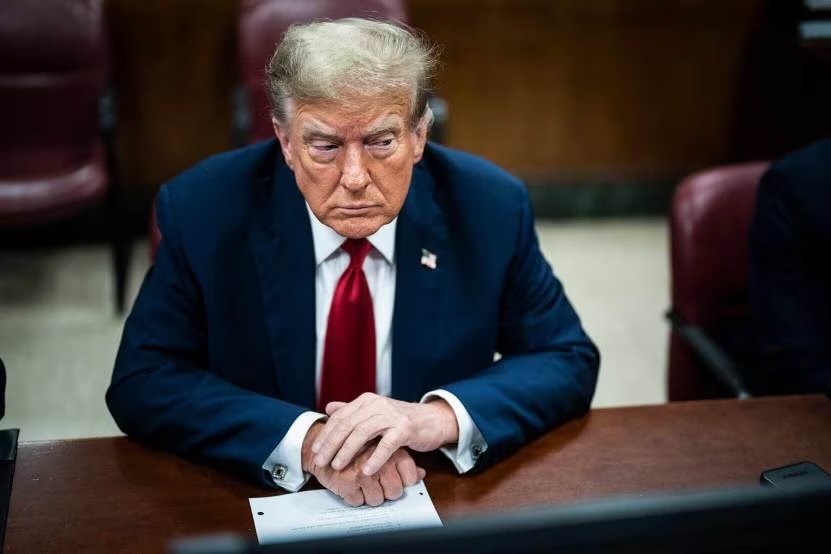
I’d say Watters was trolling us all, but I’m not sure Trump appreciates being compared to an ape. 🦧
I’m sure the ape doesn’t like the comparison.
🎶Tin Soldiers And Nixon Comin’🎶
Quite a photo. https://t.co/dqh75qyV6A
— Steve Vladeck (@steve_vladeck) April 24, 2024
Just so everyone is clear, the Governor of Texas announces he ordered the protestors at the public university arrested because he is discriminating against their viewpoint, and the police confirm they acted at his instance. pic.twitter.com/NdNfxayzSj
— southpaw (@nycsouthpaw) April 25, 2024
But you can arrest them, right, Speaker Johnson?Johnson: You cannot censor and silence viewpoints you disagree with pic.twitter.com/sCtN28xbBN
— Acyn (@Acyn) April 24, 2024
Welcome to Texas. I’m sure all the defenders of police action against college students in New York City are happy now.
Nobody does irony like Texas does irony. I’m pretty sure those jack-booted thugs will hang around to root out DEI on campus, since the Lege outlawed it in the last session.
Thank God DEI is not anti-semitism, huh?
sure, okay pic.twitter.com/ceXEbnDofJ
— Suzanne (@SoozieCuzie) April 25, 2024
It was fun while it lasted.I just signed a law protecting free speech on college campuses. #txlege pic.twitter.com/jHIh8431SH
— Greg Abbott (@GregAbbott_TX) June 10, 2019
🎶Four Dead In O-Hi-O🎶
— TJ Wells (@MrWells2011) April 24, 2024Wouldn’t that be up to the Governor of New York? Or is Biden supposed to invoke the Insurrection Act over a handful of campus assholes in New York City?
Like I say, what could go wrong with the National Guard on campus?
Except for DEI
Nobody can talk about DEI.Johnson: You cannot censor and silence viewpoints you disagree with pic.twitter.com/sCtN28xbBN
— Acyn (@Acyn) April 24, 2024
You can’t be a transgender or gender nonconforming teacher in Texas. Soon, anyway. So you can censor or silence viewpoints you disagree with., so long as you’re a Republican legislator in Texas.
Blah Blah Blah
Trump claims hush money trial judge thinks he's 'above the Supreme Court' https://t.co/W7axF11e8I
— Raw Story (@RawStory) April 24, 2024
"Because he thinks he is above the Supreme Court, he is prohibiting me from going to the presidential immunity hearing where some of the great legal scholars will be arguing the case — the most important case in many years on the Supreme Court," Trump told Fox News Digital.First question: would he stay awake?
Second question: what would he get out of it? Other than maybe hearing his name mentioned?

It’s A Real Thing
It's a thing, and it's real:Trump presenting a ‘Key to the White House’ to the former Japanese PM at Trump Tower last night. pic.twitter.com/cgWsJs6ZoK
— Ron Filipkowski (@RonFilipkowski) April 24, 2024
Special gold-tone ceremonial White House key released in very limited quantities during the presidency of Donald Trump. The key measures 8″ x 2.5″ with both sides of the bow featuring the seal of the President of the United States of America, and both sides of the shaft engraved with text: “Key to the White House” and “President Donald J. Trump.” Includes its original handsome wooden display box, 9.25″ x 4″ x 1.5″, with the underside of the lid featuring an artistic depiction of the north portico of the White House, and the top of the lid laser-engraved with presidential seal. In very fine condition. This White House-exclusive key was specially made for and presented to foreign dignitaries and other VIPs during the Trump-Pence administration.
Why it exists is another matter:
Trump’s sense of ownership of the building extended even to a souvenir he had created: a “key to the White House.” In his book “Breaking History,” Trump adviser and son-in-law Jared Kushner described the tchotchke.“When Trump met with [Israeli Prime Minister Benjamin Netanyahu], he whipped out his signature gift — an oversize bronze ‘key to the White House’ in a wooden box carved with the presidential seal. Trump had designed the key himself to give to special guests.”
" ‘This is the first key I’m giving to anyone,’ he said. ‘Even when I’m not president anymore, you can walk up to the front gate of the White House and present it, and they will let you in.’ "— "Breaking History," Jared Kushner
Kushner writes that he “tried to keep from laughing” at the presentation.
Understandably. It is not the case that presidents can simply grant other people lifetime access to the White House. Not only because of the security implications but, again, because the house isn’t the president’s to offer to others. Trump was allowed to stay there by the people; that grant isn’t transferrable.This is Trump, so I’m a little curious about who paid for this souvenir, and why Trump still has one.
And “Trump designed the key himself”? I’m old enough to remember when Carter was criticized for reports (probably apocryphal) that he concerned himself with the schedule for the White House tennis court.
Gold-tone. Trump’s name. Trump designed. It all checks out. Trump is the stain on the White House it will take a century or more to eradicate.
Eric IS The Smart One
RNC co-Chair Lara Trump: We have lawsuits in 81 states right now pic.twitter.com/3vZ8mRYvgE
— DNC War Room (@DNCWarRoom) April 24, 2024
Apparently she had just learned the consent decree out of New Jersey (for GOP poll watchers harassing black and Latino voters) had expired. But what she’s saying is aligned with “81 states.”What does this mean, they will have thugs to physically take the ballots to make sure they are marked for Republican candidates? Sounds like a perfect authoritarian election plan to me. https://t.co/yWbJfxt7w7
— Ruth Ben-Ghiat (@ruthbenghiat) April 24, 2024
I just voted (school board election) with a relatively new process meant to generate a paper trail. None of the volunteers who checked my registration and gave me the log in code, ever touched the ballot sheet. They took my driver’s license (to scan it), and handed it to me, and the slip with the code on it. But no one touched the ballot sheet except me.
I put that in the machine, cast my vote, printed the ballot, and put it in a scanner which kept the paper and recorded my vote. Nobody touched that sheet of paper but me. And no one will, except persons authorized by law to do so.
Lara Trump is not making even empty threats. She’s simply as dumb as a ream of blank paper ballots.
Trump’s been posting Rasmussen polls and Tom Fitton articles all day. So he’s winning the election and his trial bigly on Truth Social.
— Ron Filipkowski (@RonFilipkowski) April 24, 2024
Apparently this is the “campaigning” he has to miss out on during trial days.
'Welcome relief': Analyst explains why Trump's hush money trial pleases the GOP https://t.co/K6SuRfeZFb
— Raw Story (@RawStory) April 24, 2024
According to Cupp, the trial distracts the public from the fact that the GOP is on the defensive when it comes to subjects like abortion and fallout from the overturning of Roe v. Wade, for which Trump has taken credit.Well, I guess that explains this:
And this:Kari Lake: Unfortunately, Democratic officials in Arizona are not enforcing Arizona’s 1864 abortion ban with no exception for health, rape, or incest. We don’t have that law as much as many of us wish we did pic.twitter.com/DzLdxgtG2t
— DNC War Room (@DNCWarRoom) April 24, 2024
The GOP remain strategic geniuses. Dems remain in disarray.Good morning from the Arizona Capitol, where we’re in the third week of attempts to repeal the incoming territorial abortion ban, which will be among the most restrictive in the US.
— Rachel Louise Just (@RLJnews) April 24, 2024
I’m hearing from multiple people today we will see either a repeal vote or a GOP ballot referral. pic.twitter.com/SAtC5OHyyo
Barack Obama in 2008: “I traveled to 57 states.”
— Federalism Index Project (@FedIndex) April 24, 2024
Lara Trump: hold my beer. We have lawsuits in 81 states
pic.twitter.com/jH77UHf5JK
“Sometimes I Think The Narrative Is A Great, Grey God…”
The “Trump is definitely gonna win” tone of two months ago was embarrassing. The “Biden’s got this” tone after the SOTU was embarrassing. The amount to which coverage shifts every two weeks based on the whims of individual poll….embarrassing!!
— Astead (@AsteadWH) April 24, 2024
Confessions of an NYT political reporter.Ppl ask if I miss writing (I do) but my desire to get out of this type of narrative cycle was much greater than my need to write. Imo, audio can better highlight the stakes of an election w/ nuance partly because we’re untied to day to day horse race discourse
— Astead (@AsteadWH) January 23, 2024
The narrative is the fox being chased by the baying hounds, who never catch it, even after the hunt is over. And yet the Narrative is all, and must never be forsaken or questioned.
Honestly, reading political coverage in a Presidential election year is like that scene from 1984 where the enemy and ally switch places in mid-speech, and no one notices.
“Those Who Do Not Learn From History…”
Because that worked so well at Kent State!Ok so the upshot from the responses is abt what I figured. Tom cotton and Josh Hawley. Which is about what I figured. As far as I can tell the governor and the university have basically ruled out the idea, as they should.
— Josh Marshall (@joshtpm) April 24, 2024
(Young people in government is not always a good thing.)
🎶 Tin soldiers and Nixon coming/We’re finally on our own/This summer I hear the drumming/Four dead in Ohio.” 🎶
Behold The Power Of Government
When the people in government know what the fuck they’re doing, and understand national and world security apart from their petty personal attempts to rig elections with National Enquirer-style fictions.President Biden: "In the next few hours -- literally few hours -- we're going to begin sending in equipment to Ukraine for air defense munitions, for artillery, for rocket systems and armored vehicles." pic.twitter.com/Ir6XUOqY3p
— CSPAN (@cspan) April 24, 2024
"[This legislation I signed] is going to make America safer, it's going to make the world safer and it continues America's leadership in the world." pic.twitter.com/66JpbM2lS6
— Herbie Ziskend (@HerbieZiskend46) April 24, 2024
The Narrative Catches Up As Reality Takes A Breather
The headlines out of Pennsylvania for @realdonaldtrump last night are ugly. pic.twitter.com/uM4M7IUNIo
— Rick Wilson (@TheRickWilson) April 24, 2024
Haley won more than 155,000 votes in Pennsylvania's GOP primary even though she ended her campaign more than a month ago, a sign of potential trouble for Trump in one of the key battleground states this fall. @ChrisCameronNYT @anjalihuynh https://t.co/zAq9A8mEM1
— Peter Baker (@peterbakernyt) April 24, 2024
“Biden directed his senior aides to employ a two-pronged strategy: privately make clear to Johnson the stakes for Europe and the rest of the world if Vladimir Putin claims Ukraine, leaning heavily on intelligence — and lay off attacking the new speaker” https://t.co/ViqRMDIbB0
— Jonathan Lemire (@JonLemire) April 24, 2024
What was obvious to sentient beings for 8 years finally becomes “conventional wisdom.”Ironic that Trump has spent the last decade blasting legitimate media organizations as "fake news," all while working hand-in-glove with actual purveyors of fake news, supermarket tabloids, to improve his political standing
— Judd Legum (@JuddLegum) April 23, 2024
— Rick Wilson (@TheRickWilson) April 24, 2024
When The Walls Fell
30% of Republicans in PA voted against Trump for a candidate who dropped out 6 weeks ago. pic.twitter.com/nfyj3F77Q3
— Ron Filipkowski (@RonFilipkowski) April 24, 2024
Whiskey Tango Foxtrot?Trump presenting a ‘Key to the White House’ to the former Japanese PM at Trump Tower last night. pic.twitter.com/cgWsJs6ZoK
— Ron Filipkowski (@RonFilipkowski) April 24, 2024
Funny that’s not having any effect.Trump: “If you look at what the legal scholars are saying - Jonathan Turley, Andrew McCarthy, Dershowitz - they say there’s no case!” pic.twitter.com/AUfhxA2wwr
— Ron Filipkowski (@RonFilipkowski) April 24, 2024
'Republicans must step in!' Trump begs for help with legal troubles in frantic 2 a.m. ranthttps://t.co/PDIgeLppnr
— Raw Story (@RawStory) April 24, 2024
"We have a Rigged Judge, who is working for the Democrat Party and refuses to terminate this 'case,' which should have never been brought by Soft on Crime Alvin Bragg," Trump posted at 2 a.m. on Truth Social.
"Judge [Juan] Merchan should be immediately removed, and the Appellate Courts have to take over. That also applies to Corrupt Judge [Arthur] Engoron, who knew I did nothing wrong, and still fraudulently fined me $500 Million Dollars while having no knowledge of Valuation, Finance, or in any way what he was doing. Same with Judge Kaplan, who allowed a woman, who I have never met (celebrity photo line does not count!), and know nothing about, to get a lawless judgment of $90 Million Dollars. New York Justice is in shambles, and only the Appellate Courts can save it."Except the courts can’t (or won’t, because they’re rigged, too), so the GOP must.
A Republican doesn’t stand a chance," Trump raged in his overnight post. "This is not Justice."
"This New York Cabal, run by Crooked Joe Biden’s White House, is a hit job on a Political Opponent the likes of which the USA has never seen before," Trump added. "For the Good of our Country, it must be stopped. The Crooked Joe Biden Witch Hunts have to be ended. REPUBLICANS IN WASHINGTON MUST TAKE ACTION!""MOMMY!”
Subscribe to:
Posts (Atom)